






Carbon Saddle Manufacturer in China
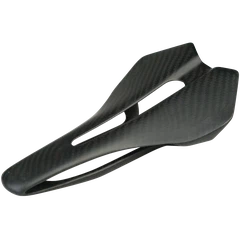
The carbon fiber saddle is made from carbon fiber, achieving the perfect balance between lightweight design, aerodynamic performance, and riding comfort. It features a carbon fiber shell and carbon fiber rails, providing maximum stiffness with minimal weight. Its ergonomic shape supports a balanced riding posture, helping cyclists maintain stability and comfort throughout their ride, making it an ideal choice for all types of cycling. Overall, the Carbon World carbon saddle is firmer than a regular saddle, providing greater support to the rider without adding any burden to your ride.
Specification of Saddle Carbon

Carbon Fiber Bicycle Seat
▪ Model: MYB11ZD05
▪ Base Material: Carbon Fiber
▪ Surface Material: PU Leather
▪ Carbon Bow: 7 x 9mm Oval
▪ Weight: 94g ± 5g
▪Color: Black/White/Pink/Blue/Orange/Red/
Yellow (Customizable)
▪ Compatible with: Most bicycles on the market: mountain bikes, road bikes, folding bikes, and touring bikes
Send Inquiry Now

Full Carbon Saddle
Model: MYB11ZD08
▪ Base Material: Carbon Fiber
▪ Carbon Bow: 7 x 9mm Oval
▪ Weight: 94 ± 5g
▪ Color: 3K Matte
▪ Compatible with: Most bicycles on the market: mountain bikes, road bikes, folding bikes, and touring bikes
Send Inquiry Now
Specification of Carbon Saddle Rails

Carbon Saddle Rails
▪ Model: MYB11ZD01-7X9
▪ Material: Carbon Fiber
▪ size: 7 x 9mm Oval
▪ Weight: 57g ± 5g
▪Color: Black Customizable)
▪ Compatible with: Most bicycle, e-bike, and tricycle seats on the market
Send Inquiry Now
If you would like more information on carbon fiber saddles and carbon saddle rail sizes, please get in touch with Carbon World.

Carbon Saddle Rails Structure
Carbon saddle rails sit under the saddle shell and work as the main support frame of a carbon-railed saddle. The structure usually has two long rail arms that run from the front section to the rear support area.
In this design, the front part is narrow and smooth, while the rear part is wider to match the saddle shell. The two side rails provide the clamping area for the seatpost, so the rail size and shape must match the clamp.
Many bike saddle carbon rails use a 7 x 9mm oval shape instead of a round metal rail. Before installation, buyers should check the seatpost clamp type and avoid uneven pressure on the carbon rails of the saddle.
Weight of Carbon Saddle Rails
The measured weight of these carbon saddle rails is about 57g. A small weight difference may occur between batches, usually due to surface finish and normal production tolerance.
This weight refers to the carbon rail part only, not the full carbon railed saddle. For buyers comparing carbon saddle rails with titanium or steel rails, the rail weight can be used as a direct reference.
For custom bike saddle carbon rails, the final weight should be confirmed according to the actual rail size and finish.


Benefits of Carbon Saddle
Ultralight Design: This carbon saddle is made entirely of carbon fiber, significantly reducing the overall weight of your bike. Its shock absorption performance is 30% better than that of ordinary bicycle saddles, effectively reducing vibrations on all terrains and absorbing impacts on bumpy roads.
Ergonomic Design: The shape conforms to the body's curves, providing stable support and pressure relief during long rides. The smooth surface and balanced contours minimize friction and fatigue.
Aerodynamic Advantages: The sleek, minimalist design reduces wind resistance, helping you maintain higher speeds with less effort.
Durability: The carbon fiber saddle is corrosion- and weather-resistant, maintaining its lustrous surface and structural integrity over time, delivering high performance and a superior appearance.
Versatility: The unisex bicycle saddle's universal design is suitable for nearly all types of riding, including road biking, mountain biking, touring, and folding bikes.
Use Scenarios Of Carbon Fiber Saddle
Standard Carbon Saddle is universally designed, easily installed, and interchangeable, and adapts to nearly every bike on the market. Whether you're riding a mountain bike, road racing bike, trekking bike, or cross-country or hybrid bike, it can easily be paired with a carbon seatpost or any other material seatpost. Furthermore, the standardized mounting interface allows riders to freely adjust the angle and fore-aft position to suit their riding style and body type, achieving optimal ergonomic support and comfort. The high compatibility and ease of installation of standard saddles make cycling more convenient, efficient, and personalized.

Carbon Saddle Rails vs Titanium Saddle Rails
| Point | Carbon Saddle Rails | Titanium Saddle Rails |
|---|---|---|
| Material | Carbon fiber composite | Titanium alloy |
| Common Shape | Usually oval, often 7 x 9mm | Usually round, often 7 x 7mm |
| Weight | Lighter in many saddle designs | Light, but usually heavier than carbon rails |
| Clamp Fit | Needs an oval rail compatible seatpost clamp | Fits many standard seatpost clamps |
| Ride Feel | Firm and direct support | Slightly more flexible and forgiving |
| Installation | Requires controlled torque and correct clamp contact | Usually easier to install and adjust |
| Best For | Lightweight road, gravel, MTB, and performance saddles | Endurance, daily riding, and wider compatibility |
| Buyer Focus | Lower weight and carbon saddle integration | Fit tolerance and everyday use |
Fit & Compatibility Guide
Matching Your Sit Bone Width: Measure the distance between your sit bones and choose a saddle that's approximately 10–20mm wider than your sit bone width for optimal support.
Saddle Rail Compatibility: Our carbon saddles feature oval carbon rails for optimal lightness and stiffness.
Installation Angle and Position: During initial installation, keep the saddle level. Based on your riding position, you can fine-tune the saddle angle (±2°) to reduce pressure. Correct fore-aft alignment helps balance force distribution and improve pedaling efficiency.
Tightening Torque: Carbon rails require a torque wrench for installation. The recommended tightening torque is 7–9 Nm. Overtightening may damage the carbon fiber structure, while undertightening may cause slippage.


Tips to Improve Your Comfort in the Saddle
Even the best carbon fiber saddle needs to be paired with proper riding habits and gear to perform at its best:
Change Your Riding Position Regularly
Stand up briefly on the pedals every 10 minutes to relieve pressure and promote blood circulation. This helps prevent numbness and discomfort during long rides.
Use Your Legs As Natural Shock Absorbers
When encountering bumps or uneven roads, slightly lift your body and let your legs absorb the impact. This reduces strain on your lower back and enhances overall comfort.
Consider Suspension Options
Choose a full-suspension bike (ideal for road riding) or a bike with a suspension seatpost (great for commuting). These options improve long-term comfort, especially on rough terrain.
Optimize Your Gear
Wear padded cycling shorts-they help reduce friction, wick away moisture, and cushion against shocks. This keeps you dry and comfortable even during long-distance rides.
How to Choose Saddle Width
Step 1: Take a simple measurement at home. Place a piece of aluminum foil or corrugated cardboard on a hard chair. Sit down in your usual cycling position for 60 seconds, then stand up and mark the two deepest indentations. Measure the distance between the centers of the two indentations – this is your sit bone width.
Step 2: Convert your measurement to the appropriate saddle width. Follow this rule of thumb: add 10-20 millimeters to your sit bone width. For example, 100-110 mm → 120-130 mm saddle, 110-120 mm → 130-140 mm saddle, 120-130 mm → 140-150 mm saddle. If you sit closer to the front of the saddle, choose a narrower width.
Riding posture is crucial. An aggressive, low-riding position usually suits a narrower saddle to facilitate hip rotation. Endurance riding or an upright riding position typically requires a wider saddle for stable support over long periods. If unsure, choose a middle width and fine-tune by adjusting the saddle's tilt and fore-aft position.


Carbon Rail Puttying Process
Surface Check After Molding
After molding and trimming, the carbon saddle rails are checked by hand and under light. Small pinholes, mold lines, sanding marks, or slight uneven areas are marked before finishing.
This step is done while the rails are still separate parts, before assembly with the saddle shell.
Cleaning Before Putty
Dust, release agent, oil marks, and sanding residue are cleaned from the rail surface. The curved arms, edges, hole positions, and wider rear section need to stay clean before putty is applied.
Thin Putty Repair
Putty is used only on small surface defects. It is not used to repair cracks, broken carbon layers, or weak areas.
The putty layer should be thin. Too much putty may change the rail shape or make the coating look uneven after sanding.
Sanding and Edge Check
After drying, the repaired area is sanded until it is level with the surrounding surface. The rail arms, clamp contact area, mounting holes, and edges are checked again so the original shape is not changed.
Before Primer and Paint
Before primer or paint, the carbon saddle rails are checked for remaining pinholes, sanding scratches, surface dust, and uneven repair marks. Only parts with a clean surface move to the next coating step.
Why Choose Carbon World?
Carbon World not only manufactures carbon fiber bicycle seats, but also designs and manufactures them. As a factory specializing in precision carbon fiber manufacturing, we ensure that every saddle that leaves our factory meets the highest standards of performance, durability, and comfort.
1. Advanced In-House Manufacturing
We control every step of the production process, from layup and high-temperature curing to finished product distribution, ensuring consistent quality and strength for every carbon fiber saddle. Of course, if our styles don't meet your needs, we can customize your shape and specifications to meet the precise requirements of professional brands and high-end dealers.
2. Premium Material Selection
We only use internationally renowned high-modulus carbon fiber (Toray) and advanced composite resins, which are lightweight, corrosion-resistant, and provide shock-absorbing properties, ensuring a smooth ride and extending the product's lifespan.
3. Rigorous Testing
We rigorously control and test our products throughout the entire process. We not only conduct random inspections, but also 100% inspection of all products. Finished products undergo rigorous impact testing, fatigue testing, and stiffness evaluation to ensure that our saddles perform flawlessly under all conditions.
4. OEM and ODM Flexibility
As a direct-sales factory, we not only offer competitive pricing but also custom design your carbon bike, carbon wheels, carbon Bike frame, and offer custom branding and packaging options.
5. Committed to Quality and Innovation
Continuous research and development keep our products at the forefront of carbon fiber technology. Partnering with Carbon World means working with a trusted factory, ensuring consistent quality, innovation, and reliability.
FAQ
Q: What are carbon saddle rails?
A: Carbon saddle rails are the lower support structure of a carbon saddle. They connect the saddle body to the seatpost clamp and help support rider load.
Q: What size are carbon saddle rails?
A: Many carbon saddle rails use a 7 x 9mm oval shape. This is different from standard 7 x 7mm round metal rails.
Q: Can a carbon-railed saddle fit any seatpost?
A: Not always. The seatpost clamp must support oval carbon rails. Buyers should check clamp compatibility before installation.
Q: Why should I use a torque wrench for carbon saddle rails?
A: A torque wrench helps avoid over-tightening. Too much clamp pressure may damage the carbon rail or leave uneven marks.
Q: What is the difference between a carbon saddle and carbon saddle rails?
A: A carbon saddle is the complete saddle. Carbon saddle rails are only the lower rail structure used for mounting and support.
Q: Are carbon saddles suitable for road and gravel bikes?
A: Yes. Carbon saddles are commonly used on road, gravel, MTB, and performance bikes where lower weight and firm support are preferred.
Q: Does the puttying process affect the strength of carbon saddle rails?
A: No. Puttying is only used for small surface defects before painting. It is not used to repair cracks, broken carbon layers, or structural problems.
Q: Can Carbon World supply only carbon saddle rails?
A: Yes. Carbon World can supply carbon saddle rails as a separate part or as part of a complete carbon-railed saddle project.


Leading carbon saddle manufacturer and supplier in China, specializing in high-quality carbon fiber products with OEM/ODM services. Our factory offers carbon bike rims, fairings, and custom carbon fiber solutions for sports, automotive, and industrial use. Contact us for a quote.
